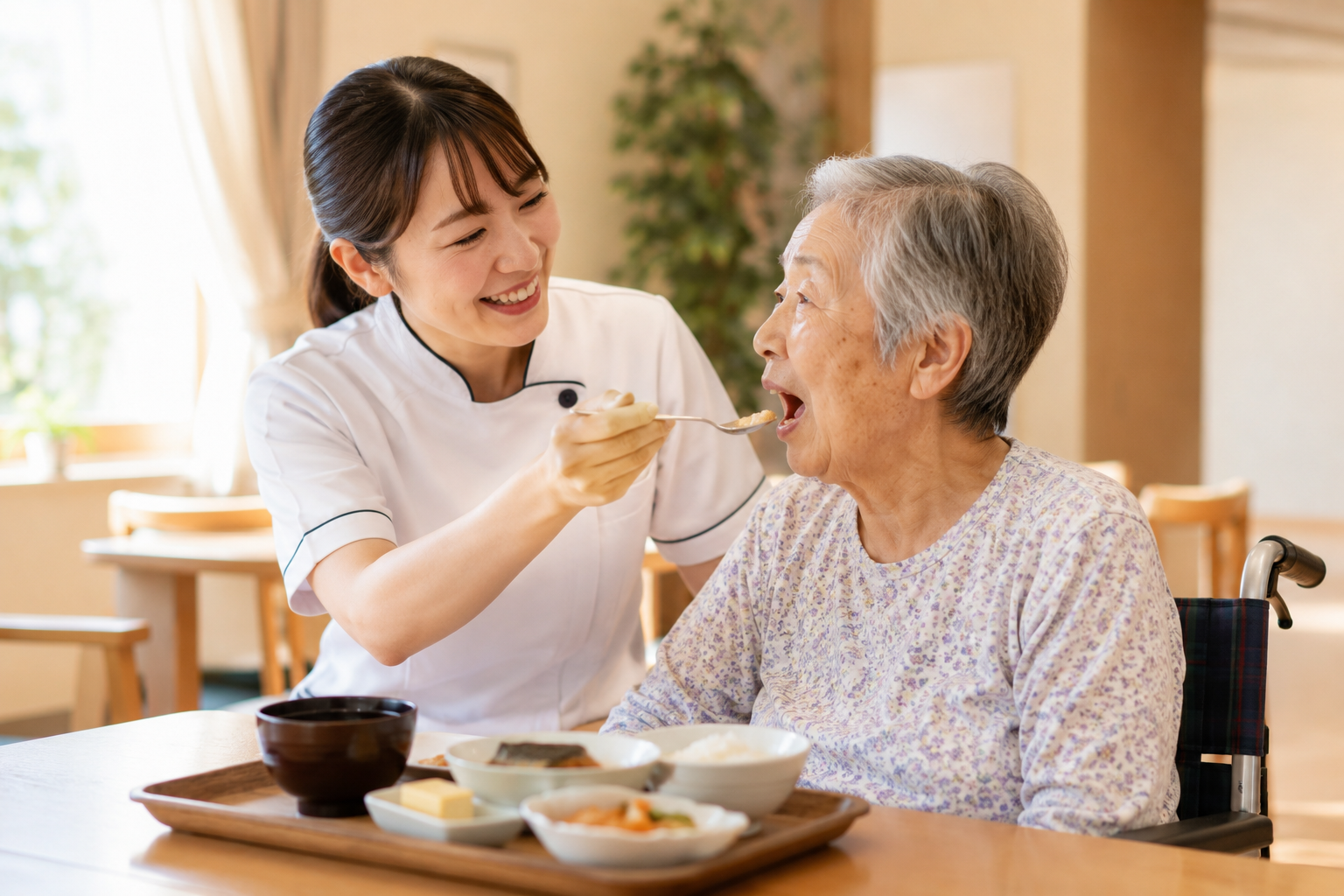
“Before I started working in Japan, I had no real understanding of the kaigo meaning — I just thought it meant looking after elderly people who could not do things on their own. Feed them. Change diapers. Simple enough. What I did not expect was how much physical and mental effort this word actually contains. Two years later, I have my own definition of kaigo — and it is nothing like the dictionary version.
What does kaigo mean?
Kaigo — 介護 — is the Japanese word for caregiving or nursing care. It refers to the support provided to elderly or disabled individuals who need assistance with daily living. In Japan, kaigo is a formal and highly regulated industry, driven by the country’s rapidly ageing population and the growing demand for professional care workers.
On paper, kaigo means helping people eat, bathe, dress, move, and maintain their dignity in daily life. In practice, it means something much deeper. It means showing up every day for people who are fighting to keep living — and making sure they feel seen, respected, and cared for while they do.
What kaigo workers actually do — a real day in the life
Every hospital and care home has its own style of working. I work in a dialysis hospital, so my experience reflects that specific environment. But the rhythm I describe here will feel familiar to kaigo workers across Japan.
My day shift begins at 9:00 AM with a team meeting. Nurses and caregivers gather together and listen to the night nurse’s report — a summary of everything that happened with each patient overnight. We take notes carefully. If there is any important new information about a patient’s condition or behaviour, we write it in the shared caregiver notes so that everyone on the team is informed.
After the meeting, the physical work begins. We start with cleaning and diaper changes — something many people do not talk about openly but that is a central and important part of kaigo work. There is nothing undignified about it when it is done with care and respect. Then we prepare tea and water for mouth care, and we get patients ready for their meals.
Caregivers take breaks one at a time throughout the day — there is always someone present and watching over the patients. At my hospital, because we work with dialysis patients, we also prepare patients for their treatment sessions on the dialysis floor. Dialysis patients each have their own schedule, which means the morning can feel like a carefully timed operation — everyone needs to be ready at the right moment.
After the noon diaper checks and various smaller tasks, my shift ends at 5:00 PM.
Every day is different in its details. But the morning meeting, the diaper changes, the meal preparation, and the dialysis preparation remain consistent. The most challenging part of managing this routine is time — dialysis patients have specific schedules, and preparing them quickly while maintaining quality care requires real focus and organisation.
Types of kaigo workplaces — what is the difference?
Not all kaigo work looks the same. The type of facility you work in shapes everything — the patients, the pace, the challenges, and the daily routine. Here is an honest overview of the main types:
Dialysis hospitals — In my experience, this is one of the most challenging kaigo environments in Japan. Each patient has an individual treatment schedule, which means the pace changes constantly. You need to be quick, organised, and always thinking ahead. There is very little room for a consistent routine because the dialysis schedule drives everything.
Day care centres — Patients at day centres can generally move around independently and communicate well. The kaigo worker’s role here is lighter — assisting where needed, supporting activities, ensuring comfort. At 5 PM, patients go home and return the next day. The work is still meaningful but the intensity is lower than in a hospital setting.
Elderly care homes — Residential care homes operate on a more consistent daily schedule than hospitals. Residents live there full time, and the routine tends to be more predictable. The emotional weight can be significant because you build long-term relationships with residents over time.
Each environment asks something different of you. Before you choose where to work, think honestly about what kind of pace and what kind of patient relationship you are ready for.
The human side of kaigo — patients, trust, and what they teach you
Working as a foreign caregiver in Japan, I was not sure how Japanese elderly patients would react to me. The honest answer is — they treat me well. They are friendly. If you speak to them politely and with genuine care, things go smoothly. Your Japanese language skills matter enormously here — the better you can communicate, the deeper the connection you can build.
Patients can sometimes get angry or frustrated. This is not personal. They are under enormous mental and physical stress — dealing with illness, loss of independence, separation from their homes and families. As a kaigo worker, you need to be prepared for that. Stay calm. Do not react. Understand the pain behind the behaviour.
I have had many memorable moments with patients over two years. Small moments — a patient who smiled when I remembered how they liked their tea, an elderly man who taught me a Japanese word I had never heard before, a woman who held my hand after a difficult procedure and said nothing, but meant everything.
What patients have taught me is this: my problems are small. I have a home to go back to. They are giving their absolute best just to keep living, just to get through another day. When I remember that, the tiredness of the work becomes something I can carry.
What makes someone truly good at kaigo
After two years of doing this work, here is what I have come to believe.
Nobody is perfect. Nobody is truly an expert in kaigo — not even someone who has worked in this field for thirty years. The work teaches you something new every single day, and the moment you think you have mastered it, something will remind you that you have not. Even the most experienced kaigo workers make mistakes. What defines them is that they acknowledge those mistakes and say sorry. Learning to apologise is not a weakness in this field — it is essential.
Arrogance will make you an outsider. In Japan’s team-based work culture, and especially in a field as human as caregiving, the person who thinks they know everything will quickly find themselves isolated. Humility, punctuality, and hard work — these are the foundations of a good kaigo worker.
Treat your patients like family. That is the simplest and truest thing I can tell you. When you approach your patients with that mindset — with genuine warmth rather than professional distance — they feel it. And they will treat you well in return.
My honest definition of kaigo
The dictionary will tell you kaigo means nursing care or caregiving. That is technically correct.
But after two years of doing this work every day, my personal definition is different.
Kaigo is the act of showing up for someone on their hardest days, helping them maintain their dignity, and reminding them — through every small act of care — that their life still has value and that they are not alone.
It is a stressful job. There will be days when you come home exhausted in ways that are difficult to explain. But it can be rewarding in ways that are equally difficult to explain — a quiet kind of reward that does not show up on your payslip but stays with you long after the shift ends.
That is kaigo. And that is why it matters. 🇯🇵
previous post: https://kaigojourney.com/2026/05/20/caregiver-in-japan-requirements-what-you-really-need-to-know/
“For more context about foreign caregivers in Japan read Why Foreign Workers Have Become Essential to Japan’s Elderly Care System.”
Leave a Reply