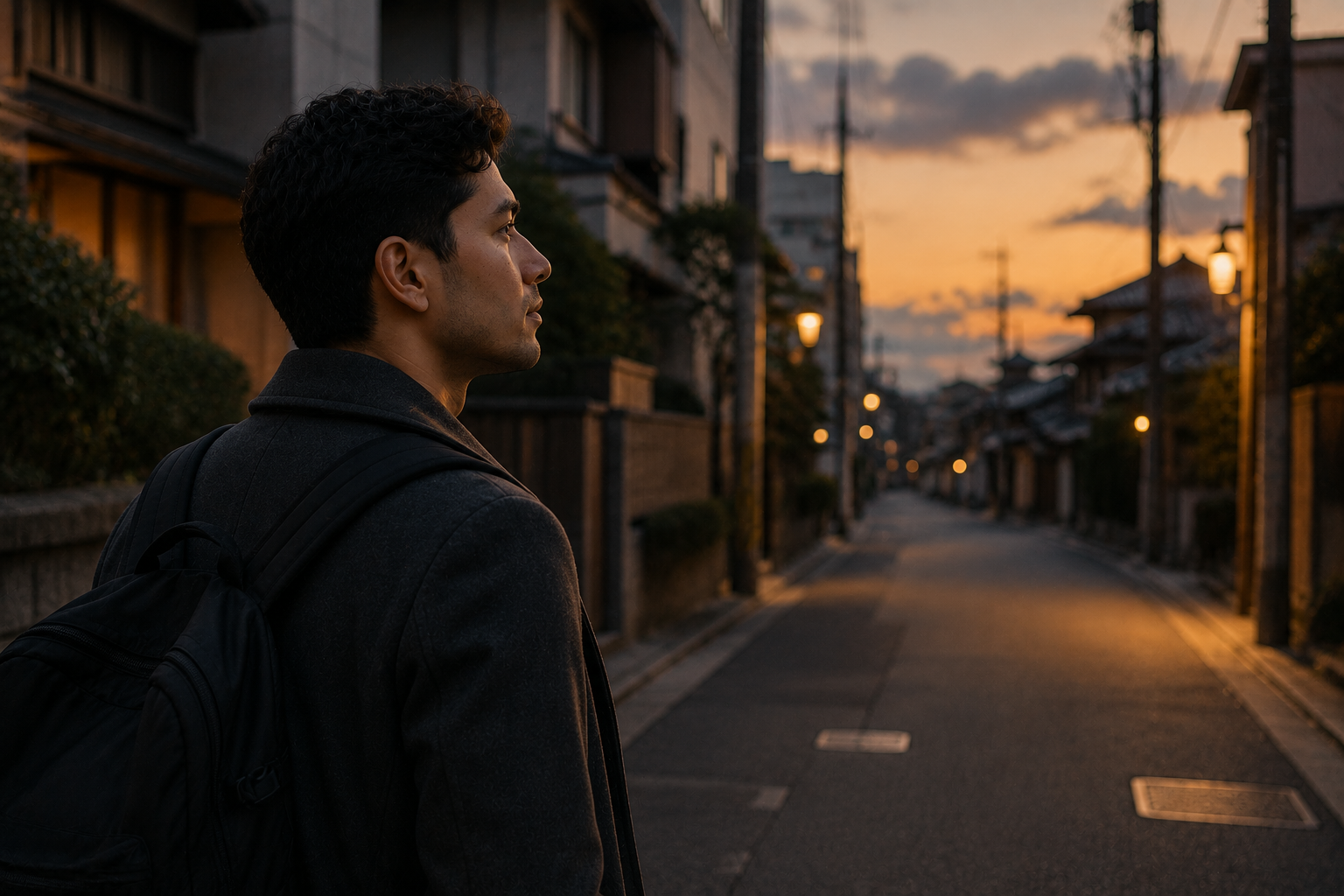
People ask me why I stay in Japan. I have been here eight years. I came for anime. I stayed for reasons I cannot fully explain. This post is my honest attempt to answer that question — not the polished version, but the real one.
The honest first answer
Sometimes I think about going back to Nepal. The thought comes quietly — after a long night shift, after a phone call with family, after a moment when Japan feels more foreign than familiar.
But when I imagine actually leaving, something in my chest resists. There is an emotional connection to this country that I did not plan and cannot fully explain. Japan became home without me deciding it would. That is the simplest and most honest thing I can say.
The other reason I stay is harder to admit. If I went back to Nepal — what would I do there? I cannot find a clear answer to that question. The life I built here has no obvious equivalent waiting for me there. So in some ways, I stay because leaving feels more uncertain than staying.
You could say I am lost between two places. And that would not be wrong.
What I love about Japan — and why I cannot explain it
If you ask me what I love about Japan, I struggle to give you a list. It is not the convenience stores, or the train system, or the cherry blossoms, or any of the things travel blogs write about. It is something less definable than all of that.
Japan simply became home. Not through a decision. Not through a romantic moment. Through the accumulation of eight years of daily life — the walks to work, the convenience store breakfast, the changing seasons, the quiet streets at night, the particular quality of light in autumn. All of it, slowly and without announcement, became familiar. And familiarity became attachment. And attachment became home.
What I miss about Nepal is clearer: my family and food. Those two things — so simple to say, so heavy to carry — are what eight years of distance actually feels like. The taste of home. The faces of the people who knew me before Japan shaped me into whoever I am now.
The biggest sacrifice nobody warned me about
The biggest sacrifice of staying in Japan is not the salary, or the work culture, or the loneliness — though all of those are real. The biggest sacrifice is time with family.
I used to believe that having money meant nothing could stop you. That if I could earn enough, I could provide everything my family needed, and that would be enough. I was not wrong exactly — money does matter, and providing for the people you love is meaningful. But I was missing something.
The biggest reward is not money. It is family. I learned this slowly, through absence, through phone calls that never quite fill the gap, through realising that what my family wanted most was not what I sent home every month — it was me, present, in the room.
You need to balance family and finances. That sounds simple when you read it. It is not simple when you are living it from ten thousand kilometres away.
Caught between two worlds
After eight years, I am not fully Japanese. I will never be fully Japanese — the language, the culture, the unspoken rules will always carry some distance for me. But I am no longer fully Nepali either.
Sometimes I forget words in my mother tongue. They slip away quietly, replaced by Japanese equivalents that come faster now. Sometimes I find myself thinking in Japanese — not just speaking it, but processing the world through it. Japan has rewired something in how I see and respond to things.
This is one of the stranger costs of long-term life abroad that nobody prepares you for. You gain fluency in a new culture while slowly losing some fluency in your own. You become a third thing — not quite either, shaped by both. It is not painful exactly. But it is real, and it is permanent.
What Japan gave me that Nepal could not have
I want to be fair to Japan, because despite everything complicated, what this country gave me is real and significant.
I earned money I could not have earned at home. I gained life experiences that changed how I see the world. I grew — from a naive young person with anime dreams and no real understanding of how society works, into someone who can read people, navigate complexity, and see through appearances.
Japan taught me that money is not everything. It taught me not to be fooled by surfaces — not by people’s politeness, not by a country’s beautiful image, not by promises that sound good but need to be examined carefully.
If I had gone back to Nepal eight years ago, I would have missed all of this. The essential human experiences. The insights into how the world actually functions. The harder, truer understanding of life that only comes from leaving everything familiar and building something from nothing in a foreign place.
I would be a different person. Probably a simpler one. I am not sure whether that would have been better or worse — only that it would have been different.
What Japan really is — beyond the cherry blossoms
If you are reading this because you are considering coming to Japan — there is something I need you to understand before you arrive.
Life in Japan is not always like the beautiful cherry blossoms. That image — delicate, perfect, briefly stunning — is real, but it is only one season. Japan also has 40-degree summer heat that drains you completely. It has storms. It has earthquakes. It has a loneliness that is particular and specific — the feeling of being surrounded by people and still somehow isolated, of being present in a society that will never fully include you.
I am not talking about the weather. I am talking about the conditions of life here — the emotional and psychological reality of being a foreigner in Japan long term. It can make you feel fixed in one place, unable to move forward or go back, watching time pass from inside a life you built but did not entirely choose.
If your mental health is strong and you can genuinely handle these challenges — staying is possible. More than possible. But go in with your eyes open, not through the lens of anime or travel blogs or the dreams of who you were before you arrived.
Would I do it again?
After eight years. After the visa crisis that forced me into caregiving. After the loneliness, the growth, the money sent home, the family moments missed, the Japanese I dream in now, the Nepali words I sometimes forget.
If I had the chance to do it all over again — I would make different choices.
I cannot deny what Japan gave me. The opportunities, the growth, the person I became here — all of that is real and I carry it with gratitude. But I also carry the weight of what it cost. And if I could go back and choose with the knowledge I have now, I would choose differently.
I do not say this with bitterness. I say it with the clarity that only eight years of living something can give you. My experiences shaped who I am today. And who I am today is someone who understands — finally, deeply — that the life you build matters less than the people you build it with.
Japan is my home. Nepal is my heart. And somewhere between the two, I am still figuring out who I am. 🇯🇵🇳🇵
Related posts
→ Want to know what 8 years in Japan really taught me? Read 8 Years in Japan — What I Wish I Knew on Day One.
→ Curious about how learning Japanese changed me? Read How Learning Japanese Changed Me as a Person.
→ Want to know what nobody tells you before coming to Japan? Read What Nobody Tells You Before Coming to Japan as a Caregiver.
“For more context about foreigners living and working in Japan read Why Foreign Workers Have Become Essential to Japan’s Elderly Care System.”
Leave a Reply