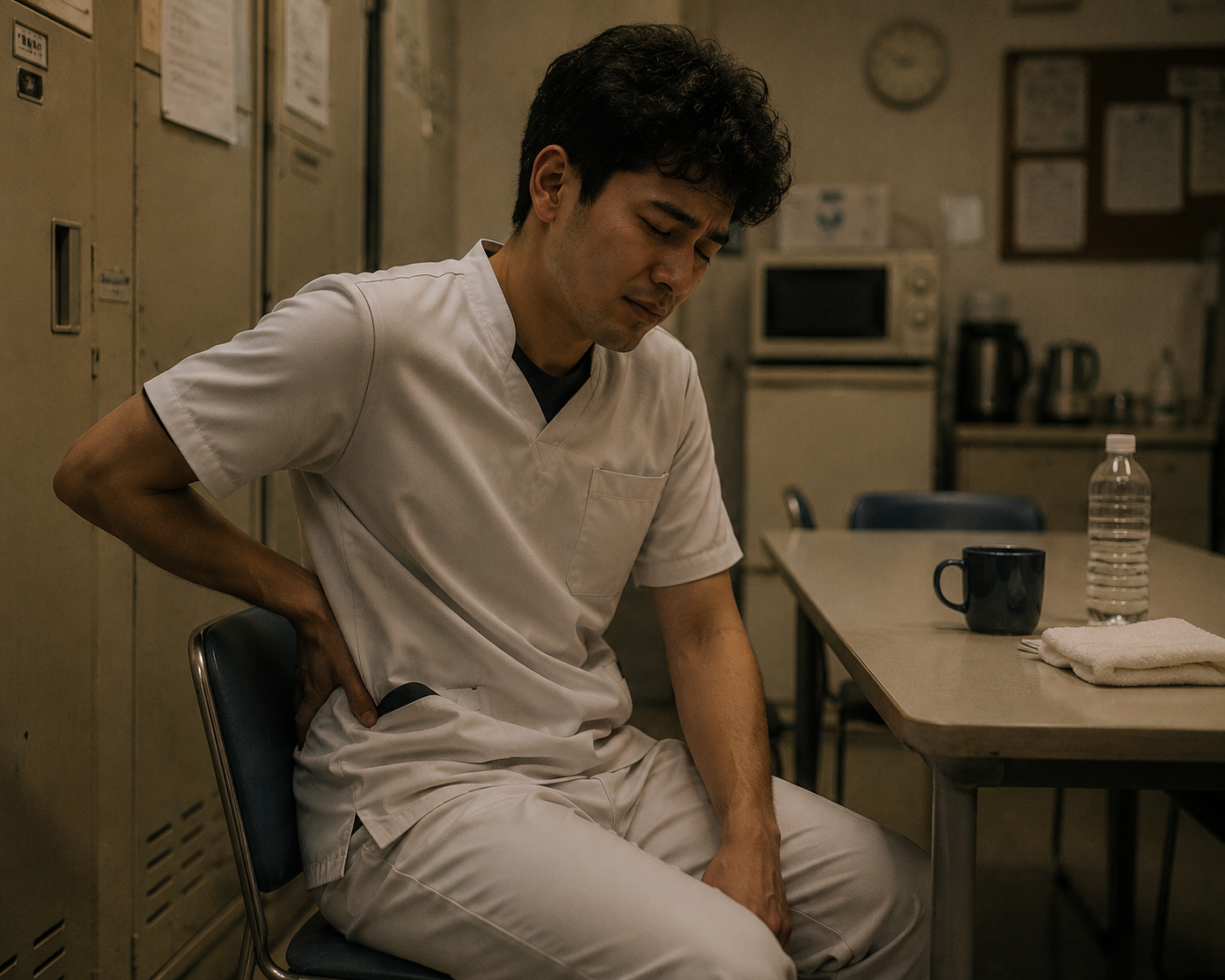
Nobody warned me about what this job would do to my body. Two years later, my back, hands, and legs hurt regularly. Everyone at my hospital carries some version of this pain. This post is the warning I never received — and that you deserve to hear before you decide.
What two years of caregiving has done to my body
After two years of caregiving in a Japanese dialysis hospital, my upper back, lower back, hands, and legs hurt regularly. The upper and lower back carry the most consistent pain — the daily physical demands of this work accumulate in your spine in a way that does not fully go away between shifts.
I do not believe I have permanent damage yet. But I want to be honest about something that I have heard from colleagues who have been doing this work for longer: this pain is not going to heal unless you quit the job. That is not pessimism. That is the reality of sustained physical caregiving work over years.
Nobody warned me about this before I started. Not the agency, not the employer, not any blog I read. KaigoJourney exists partly so that you get the warning I did not.
The hardest tasks on your body
The most physically demanding task in my daily caregiving work is changing diapers. This is not because lifting and repositioning patients is easy — it is not. But diaper changes require a specific posture and sustained physical effort that places enormous strain on your back, especially when repeated two to three times in an eight hour shift for every patient in your care.
Lifting and repositioning patients is also genuinely hard — but in my hospital, the dialysis schedule creates fixed time windows for these tasks, which provides some structure. The most difficult patients to care for physically are those who are paralysed or cannot move freely. When a patient cannot assist with their own repositioning, you carry the entire weight and effort with your own body. Patient weight ranges from 40 to 80 kilograms in my experience — and weight matters much less than mobility. A 50 kilogram paralysed patient is far harder to care for physically than an 80 kilogram patient who can still move.
Looking around my hospital honestly — I believe almost everyone carries some level of back, hand, or leg pain from this work. It is not spoken about openly. But it is there.
How to protect your body — practical techniques
My hospital provides no physical training and no lifting equipment. If you want support, you pay for it yourself. This may not be true everywhere — some facilities invest more in staff physical welfare — but do not assume support will be provided. Ask specifically before you accept any job offer.
Here is what I have learned through experience about protecting your body:
Use a back pain belt. This is the single most practical thing you can do. A back support belt worn during physically demanding tasks reduces strain significantly. Buy one before your first month if possible.
Never bend your back completely. When changing diapers or performing tasks at patient level, bend your knees and only slightly bend your back. I made the mistake in my early months of relying too much on my back strength rather than my whole body. That mistake is still with me. Learn the correct technique from your first day — not after the pain has already started.
Engage your whole body. Use your legs, your core, your arms — distribute the physical load rather than concentrating it in your lower back. This sounds simple and obvious. In practice, in a busy shift under time pressure, it is easy to forget and revert to bad habits.
For pain management after shifts — I use Japanese rokisopurofen-based pain relief patches for localised pain. If the pain persists, medication. I have not yet seen a physiotherapist, but I am planning to — and I would recommend not waiting as long as I have. Early physiotherapy intervention prevents the kind of accumulation that becomes chronic.
The mental side of carrying physical pain
Physical pain is real — but I try not to let it affect my mental health. In caregiving, if you become mentally exhausted on top of physically exhausted, your performance suffers and your patients feel it. I keep the two as separate as I can.
That said, I want to be honest about the long term picture. If I choose to do this work for many years, there is a real possibility of permanent physical damage. The spine does not recover fully from sustained repetitive strain. In the worst case scenario — and I say this not to frighten but to be truthful — long term caregiving without proper technique and body care could contribute to serious spinal problems in the future.
This is the information that recruitment agencies and employers do not volunteer. You have the right to know it before you sign anything.
Who should and should not do this work
If you have an existing back problem, chronic joint pain, hearing difficulties, or any condition that affects your physical ability to perform sustained manual work — think very carefully before pursuing caregiving in Japan. Not to give up on your Japan dream. But to protect the body you will need for the rest of your life.
The body type and physical condition best suited for this work is genuinely strong, flexible, and injury-free. Not because weak people cannot do the job — but because the physical demands will find and amplify any existing weakness over time.
Before starting, ask yourself honestly: Am I physically and mentally strong? If the answer is yes — you can proceed with realistic expectations. If the answer is uncertain — take more time to prepare your body before you arrive.
Is it worth what it does to your body?
After two years of carrying this physical cost — my honest answer is no. The physical and mental demands of this work are significant, and the salary does not reflect that adequately. That is the uncomfortable truth that I think people in this industry should say more clearly.
But I also want to say this: what ultimately matters most is whether you genuinely love this work. I have not met many people who truly love caregiving — it is hard to love something that costs this much. But the people who do love it — who find meaning in showing up for patients on their hardest days, who feel called to this kind of care — they carry the physical demands differently. For them, the equation may calculate differently than it does for me.
If you love this work — truly love it — then perhaps the physical cost is worth it for you. Only you can answer that honestly.
But go in knowing the cost. Your body deserves that honesty before your first shift. 🇯🇵
This post reflects personal experience and is not a substitute for professional medical advice. If you are experiencing chronic pain, please consult a doctor or physiotherapist.
Related posts
→ Want to know how I deal with burnout from this work? Read Caregiver Burnout in Japan — How I Deal With It.
→ Curious about the age limit for caregiving in Japan? Read Age Limit for Caregiver in Japan — Everything You Need to Know.
→ Want to know what a real day in caregiving looks like? Read A Day in the Life of a Caregiver in Japan — The Honest Version.
“For more context about foreigners living and working in Japan read Why Foreign Workers Have Become Essential to Japan’s Elderly Care System.”
Leave a Reply