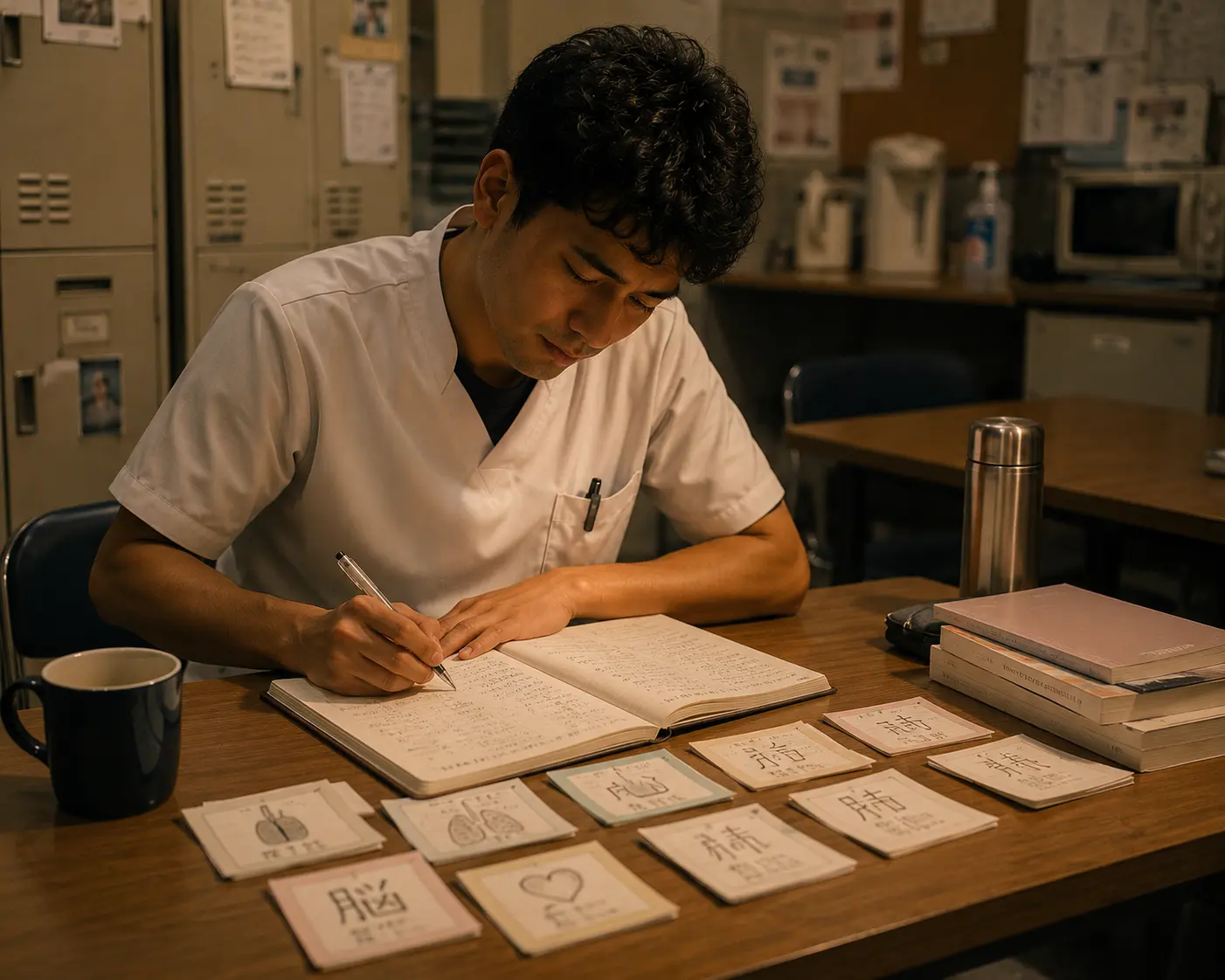
Learning Japanese for caregiving is completely different from learning Japanese for daily life. After 8 years in Japan and 2 years of caregiving, I can tell you exactly what works, what does not, and why the Japanese you study at home will feel completely different when you arrive. Here is the honest guide nobody else has written.
Why caregiving Japanese is different from general Japanese
Most people preparing for caregiving in Japan study general Japanese — JLPT vocabulary lists, grammar textbooks, conversation apps. This is a good starting point. But it is not enough, and here is why.
In general conversation, a language mistake is usually forgiven as a learner error. In caregiving, a language mistake can directly affect patient safety and dignity. When you misunderstand a medical instruction, miss a patient’s complaint, or write an incorrect incident report — the consequences are real and immediate. The stakes of language errors in caregiving are fundamentally different from the stakes in everyday conversation.
Research confirms this gap. Although the JLPT and other proficiency frameworks focus on basic interpersonal communication skills, they do not cover caregiving situations and vocabulary at all. This means even someone who passes N1 — the highest JLPT level — may not be prepared for the specific language demands of caregiving work in Japan.
What caregiving Japanese actually requires
Technical vocabulary beyond JLPT. Standard language courses teach common nouns and verbs. Caregiving requires specialized terminology for medical conditions, anatomical terms, and specific care procedures — words like ijou (patient transfer), fukuyaku (medication administration), and dozens of body-related terms that do not appear in standard JLPT curricula until advanced levels, yet are essential from your very first shift.
Keigo — formal and honorific Japanese. While casual conversation allows flexibility with politeness levels, caregiving requires consistent use of Keigo — honorific and humble expressions — when speaking with patients, seniors, and medical staff. This is a layer of the language that most textbooks introduce late and most language apps barely touch. In caregiving, it is not optional.
Koekake — speaking to make patients feel safe. One of the most important and least discussed aspects of caregiving Japanese is koekake — the practice of calling out or speaking to patients during care activities to ensure they feel informed and safe. Before bathing, before moving someone, before any procedure — you announce what you are doing, in specific, reassuring language. This is not in any standard textbook. It is learned on the job.
Reporting language. Every shift ends with a verbal and written handover. You must communicate what happened during your shift — patient conditions, incidents, changes — clearly and professionally to supervisors and medical staff. Strong vocabulary is essential for patient safety, teamwork, and daily reporting — including clear handover between shifts and reduced mistakes in care routines.
My personal study method — what actually worked
When I started caregiving I had already passed N3 and had conversational ability at approximately N2-N3 level from six years of living in Japan. Even with that foundation, the caregiving-specific vocabulary was new and challenging.
My method was simple and it worked better than any resource I could have bought:
The 24-hour notebook. In my first month, I kept a notebook with me at all times — even during shifts. Every time I encountered a word I did not know, I wrote it down immediately. After the shift, I asked a senior colleague what it meant. That notebook became my most valuable study resource — a personalised caregiving vocabulary list built from real situations in my real workplace.
Asking seniors directly. On my first week, I asked a senior caregiver for a list of the most important vocabulary specific to our hospital and our patients. That targeted list — words actually used in our environment — taught me more in one week than months of general study could have.
Karada de oboeru — learning with your body. There is a Japanese concept — karada de oboeru — which means learning through your body rather than through books. After my first month of note-taking, I stopped writing and started watching, doing, and absorbing. The language of caregiving is embedded in the physical actions of the work. You learn “how to say transfer” by doing transfers. You learn “how to report pain” by actually reporting pain situations. The body learns what the mind alone cannot.
Manesuru — copy exactly, then make it your own. The Japanese concept of manesuru means to imitate precisely — to copy how your senior speaks, moves, and communicates until it becomes natural for you. I applied this to language as much as to technique. I listened to how experienced caregivers spoke to patients, how they reported to nurses, how they handled difficult moments — and I copied exactly until I found my own voice within that framework.
The most important words to learn first
Before anything else — before grammar, before Keigo, before report writing — learn the basic safety vocabulary. The words that come up in urgent or immediate situations:
Patient (患者 — kanja). Bed (ベッド — beddo). Pain (痛み — itami). Blood (血液 — ketsueki). Medicine (薬 — kusuri). Fall (転倒 — tentou). Emergency (緊急 — kinkyuu). Help (助けて — tasukete).
These are not glamorous vocabulary items. But knowing them immediately — without having to think — could be the difference between responding correctly and freezing in a critical moment.
Learn 10 words per day by category. Use role-play dialogue practice. Pair each word with one real workplace sentence. Do not study vocabulary as isolated translation — train it in real care scenarios for faster retention.
What to do when you do not understand
This will happen — especially in your first weeks. A patient says something you cannot parse. A senior gives an instruction too quickly. A medical term appears in a report that you have never seen.
The answer is always the same: ask. Ask immediately. Ask without embarrassment.
I have been nervous in these moments too. Everyone has. But panicking or pretending to understand when you do not is the most dangerous response possible in a caregiving environment. A small misunderstanding can lead to serious consequences for a patient. There is no shame in saying “sumimasen, mou ichido onegaishimasu” — “excuse me, could you say that again please.” There is only professionalism.
Which skills matter most — listening, speaking, reading, or writing?
In caregiving, all four matter — but not equally for everyone. The honest reality from my hospital: not every foreign caregiver can read and write Japanese fluently. Many manage primarily through listening and speaking. If your spoken and listening ability is strong, you can function in caregiving even if your reading and writing need more development.
That said — strong vocabulary is essential for patient safety, teamwork, and daily reporting. Find your strongest skill and develop it first. Reading-oriented learners should lean into report writing. Speaking-oriented learners should focus on patient communication and koekake phrases. Writing-oriented learners will find documentation comes naturally. There is no single right method — only the method that works for you.
The honest truth about Japanese in Japan vs Japanese from home
Even someone who has passed N1 does not necessarily have the highest level of conversational ability — because the JLPT tests reading and listening but not production. The Japanese you study at home from textbooks and apps will feel different when you arrive in Japan. The speed, the accent, the casual contractions, the regional variations — all of these create a gap between what you studied and what you hear in a real hospital ward.
This gap is normal. It is expected. It closes with time and immersion. Do not let it discourage you before you arrive or in your first weeks. At N4, a worker can understand basic Japanese in everyday situations, comprehend simple conversations spoken clearly, and read texts using basic vocabulary and kanji — this is sufficient for kaigo work, including understanding care instructions, communicating resident needs to colleagues, and holding basic conversations with elderly residents.
My honest advice before you arrive
The most important thing to focus on before coming to Japan is understanding Japanese words properly. Grammar can be imperfect — if you understand nouns, verbs, and the meaning of what is being said, you can function. Vocabulary is the foundation everything else rests on.
What you cannot learn at home — no matter how hard you study — is Japanese manners. The specific social etiquette of Japanese caregiving environments, the unspoken expectations around how you speak to patients versus seniors versus nurses, the particular way koekake works in a real ward — these can only be learned in Japan, in the environment, by watching and doing.
So here is my honest final message: if you have passed N4 — come. Do not wait for perfect Japanese. Do not let language fear keep you in your home country when the door to Japan is already open. Your Japanese is good enough to start. Japan will teach you the rest.
The Japanese you need for caregiving cannot be fully learned from a book. It lives in the work itself — in every patient interaction, every handover report, every koekake phrase spoken in a quiet hospital ward. Come and learn it there. 🇯🇵
Related posts
→ Want to know which JLPT level you really need for caregiving? Read JLPT N4 vs N3 — Which Level Do You Really Need for Caregiving in Japan?
→ Curious about how learning Japanese changed me as a person? Read How Learning Japanese Changed Me as a Person.
→ Want to know what nobody tells you before coming to Japan? Read What Nobody Tells You Before Coming to Japan as a Caregiver.
For more context about foreigners living and working in Japan read Why Foreign Workers Have Become Essential to Japan’s Elderly Care System.
Leave a Reply