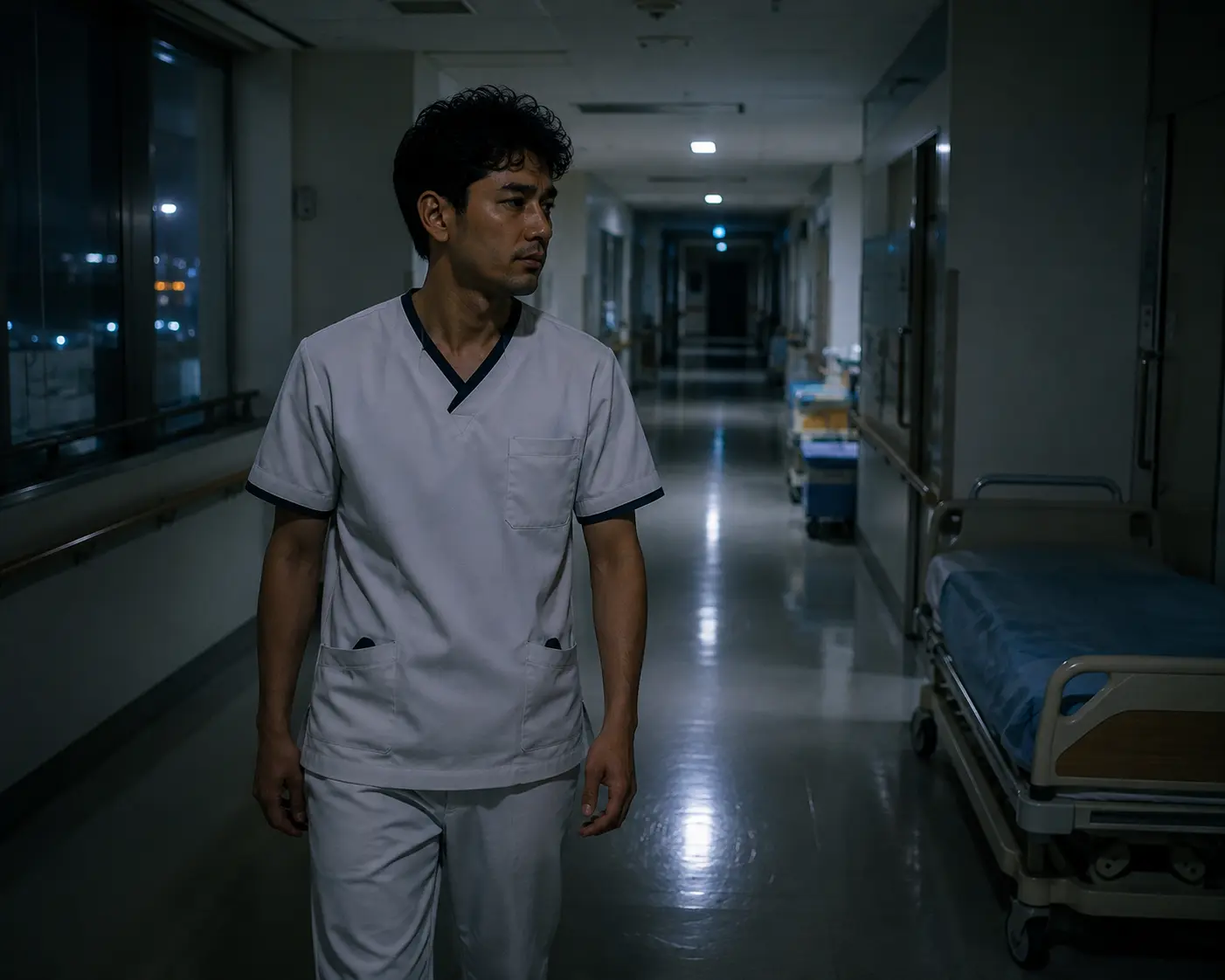
17 hours. 38 patients. ¥8,000 extra per shift. I do 6 to 8 night shifts every month — not because I want to, but because my day salary is not enough. This is exactly what a night shift in a Japanese hospital looks like, hour by hour, and what it costs you.
Why I do night shifts — the honest reason
Let me be direct about my motivation: I take night shifts because my day salary is too low without them.
My base salary is ¥149,000 plus a ¥7,000 allowance. That alone is not enough to live comfortably in Japan while saving meaningfully. Each night shift adds ¥8,000 — and with 6 to 8 night shifts per month, that adds ¥48,000 to ¥64,000 to my monthly income. That is the difference between surviving and actually saving money.
Japanese labour law requires an additional 25 percent pay on top of the base hourly rate for night shifts. This is not employer generosity — it is legally mandated compensation for the health and lifestyle costs that night work imposes. Understanding that helps you see night shift pay for what it actually is: compensation for damage, not a bonus.
My night shift — hour by hour
My shift runs from 16:30 to 9:30 the next morning — that is 17 hours. In Japanese caregiving facilities, a night shift is typically 16 hours of work from evening to the next morning, so my shift is on the longer end but within the normal range for this industry.
16:30 — Meeting with the day shift nurse for handover. 30 minutes of receiving information about every patient’s condition, changes, and anything requiring attention overnight.
17:00-17:30 — Preparation. Getting water, checking on patients, reading the caregiver notebook, completing small tasks before the evening routine begins.
17:30 — Preparing patients for meals. Putting on aprons, helping patients sit up and get ready to eat.
18:00-19:00 — Serving food, assisting patients who cannot eat independently, cleaning dishes, helping everyone rest afterward.
19:00 — My meal arrives. I have 30 minutes to eat. But I prefer to finish my work first — so I usually use this time for writing tasks and eat later, after the diaper changes are complete.
19:30-20:45 — Diaper changes for all assigned patients. This is the most physically demanding part of the entire shift.
Break time — My hospital has three floors, with night shifts covering the 2nd and 3rd. On the 2nd floor, break is 21:00 to 01:00 — four hours during which you can sleep if there are no emergencies. On the 3rd floor, break is 23:00 to 03:00.
After break — Small tasks throughout the remaining hours, with patient checks every hour through the night.
04:30 — The cycle begins again. Diaper changes, food preparation, morning routines.
08:30 — Checking diapers for patients scheduled for dialysis that day.
09:00 — Day shift staff arrive and take patients to the first floor dialysis centre. My shift ends at 09:30.
The patient ratio nobody talks about
Here is a number that should give anyone considering night shifts pause: there are 21 patients on the 2nd floor and 38 patients on the 3rd floor during night shifts.
That is significantly higher than day shift ratios, because fewer staff work overnight. You are responsible for more people, with less support, for longer hours, while your body is fighting its natural sleep cycle.
Research on Japanese healthcare confirms the risks this creates. A study of healthcare workers found that long working hours, numerous night shifts, and few days off were associated with low patient safety culture — and even after adjusting for working hours, the number of event reports increased with an increase in the number of night shifts.
In plain language: more night shifts means more incidents. This is not a personal failing — it is a documented systemic reality of night work in healthcare.
What 17 hours does to your body and mind
After a 17-hour night shift, I am too tired to do anything. It takes a full day to recover. I typically sleep around 12 hours after finishing.
But the effects go beyond simple tiredness. Night shifts have affected my cognitive function in ways I did not expect. Sometimes I forget what I am trying to do mid-task. Sometimes my brain simply goes blank. That fog is real and it is one of the least discussed consequences of sustained night work.
There are lifestyle effects too that nobody warns you about. Recovery from fatigue takes progressively longer over time. It becomes genuinely difficult to distinguish between night and day. You start avoiding outdoor activities because your sleep schedule does not align with daylight — and when you do go outside for fun, your skin can become irritated by sun exposure that your body is no longer accustomed to.
These are small things individually. Together they add up to a life that slowly disconnects from the normal rhythm of the world around you.
What nobody told me before my first night shift
The physical demands I expected. The long hours I expected. What I did not expect was how toxic the caregiving environment can become at night.
There is a lot of negativity in caregiving centres — people talking badly about colleagues without really knowing them, gossip that circulates in the quiet hours, workplace dynamics that intensify when few people are present and everyone is tired. This social atmosphere is one of the most draining aspects of night work and almost nobody writes about it honestly.
Go in knowing this exists. Do not participate in it. Do your work, be professional, and protect your own peace of mind.
How to prepare and survive night shifts
Before the shift: I wake up around noon or 2 PM on night shift days. I eat, drink coffee, and relax until 4 PM. My workplace is close to home which helps enormously — if you have a long commute, factor that into your preparation time.
During the shift: Coffee, food, and using free moments to watch videos or rest mentally. Small things that keep you alert and human across 17 hours.
For your first night shift specifically: Prepare coffee, energy drinks, or snacks you actually enjoy — comfort matters more than you think at 3 AM. If anything happens with a patient, notify the nurse immediately. Day and night shifts operate very differently and you should never guess when you are uncertain. Do not be afraid — just do your best and take care not to burn out.
After the shift: Come home, eat something you enjoy, and rest properly. Recovery is not optional — it is part of the job.
One important note: in many facilities, you start working night shifts after experiencing day shifts for a certain period, and you will not be alone at first — you will work together with experienced caregiver staff who teach you until you get used to it. If your employer expects you to do night shifts alone from the beginning without training, that is a red flag worth raising.
Is it worth it? My honest answer
No. Working night shifts is not worth the physical and mental toll it takes.
But my salary is only ¥140,000-¥156,000 without them — so I feel compelled to take them for the extra money. That is the honest, uncomfortable truth of caregiving economics in Japan. Night shifts are not a choice made freely. They are a choice made because the base salary is insufficient.
If you need money quickly and are willing to accept the challenges — do it. But if you can afford to wait, consider holding off for six months to a year before committing to night shifts. Build your experience, learn the environment, understand your patients, and let your body adapt to caregiving work before adding the burden of night rotation.
There are many downsides to working nights. The only real benefit is the increased pay. Know that equation clearly before you sign up for it.
17 hours. 38 patients. ¥8,000. Decide honestly whether that trade makes sense for your life. 🇯🇵
This post reflects personal experience and is not a substitute for professional medical advice. If night shift work is affecting your health, please consult a doctor.
Related posts
→ Want to see how night shifts affect my actual salary? Read Here’s My Actual Payslip as a Caregiver in Japan — The Numbers Might Surprise You.
→ Curious about the physical toll of caregiving work? Read Physical Demands of Caregiving in Japan — What Nobody Warns You About.
→ Want to know how I deal with burnout from this work? Read Caregiver Burnout in Japan — How I Deal With It.
For more context about foreigners living and working in Japan read Why Foreign Workers Have Become Essential to Japan’s Elderly Care System.
Leave a Reply