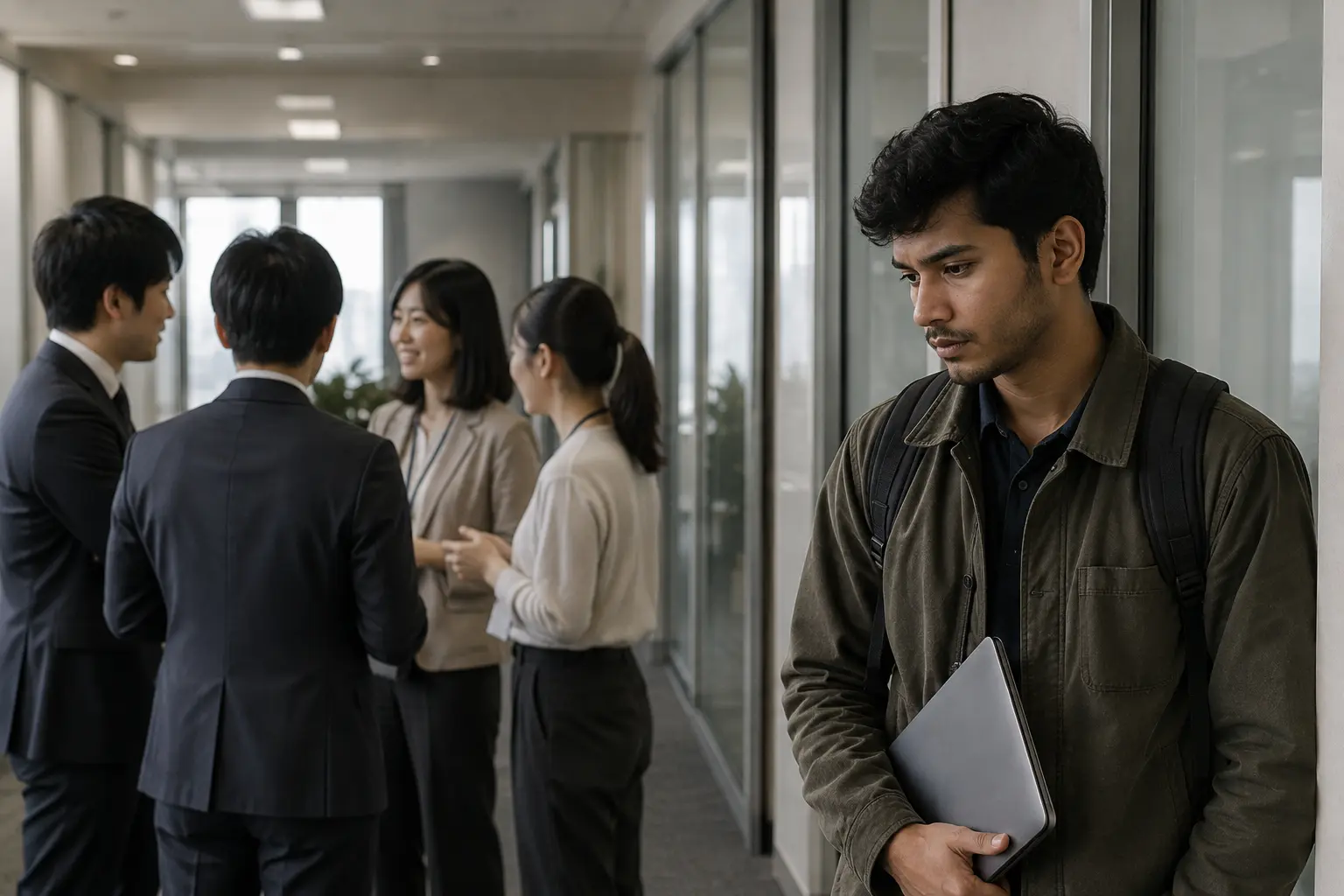
My first job in Japan was lifting heavy freight for ¥1,100 an hour on twelve-hour shifts, being spoken to like I was nothing. Eight years later I understand what was culture, what was a bad employer, and — this is the part nobody told me — what was actually illegal.
The first shock
My earliest job in Japan was at a logistics company, lifting heavy items on twelve-hour shifts, two days a week.
Two things shocked me. The wage — ¥1,100 an hour for work that was physically punishing. And the way we were spoken to. Management addressed us with a disrespect that made us feel like we were being treated as something less than workers.
I had expected Japan to be orderly, polite, systematic. All the things people say about it. I had not expected that the politeness other people describe might not extend downward to someone doing manual labour with limited Japanese.
Was that Japan, or was that one bad employer?
This is the question I have spent years answering, and the honest answer is: mostly Japan, but not in the way people assume.
It is broadly the same everywhere, especially if your Japanese level is low. That last part matters more than nationality. If your Japanese is good, you can talk to people and clear up misunderstandings. Without the language, you are simply lost — and being lost is what makes you a target.
I hear about it most in restaurants and heavy labour environments. And yes, Japanese staff are usually treated a little better. But a Japanese person who is not performing well gets treated harshly too. Whether you are Japanese or foreign, if you cannot communicate effectively, the difference is smaller than you might think.
Even with weak Japanese at the start, I tried to communicate. I did not pretend to understand things I hadn’t understood. And when I knew I was not in the wrong, I said so. That mattered more than fluency did.
The seniority system, and why hard work is punished
This is the most frustrating part of working in Japan, and it took me years to accept it.
Seniority gives some people a sense of entitlement — including the entitlement to speak badly about others. And when you work hard, what you receive is more responsibility at the same pay. If you push back or point out a better way of doing something, that gets read as rudeness rather than initiative.
So I changed my approach. I do not work as hard as I once did. That does not mean I slack — I go in, complete my responsibilities properly, and then leave the conflicts alone. I do my day and I relax afterwards.
I am not proud of that, exactly. But it is the rational response to a system that rewards effort with more work rather than more money. If your supervisor is Japanese and you are a foreigner with limited language, expect this to be harder still.
How to tell you’re being criticised when nobody says anything
In Japan, criticism is rarely given to your face. This is the part that leaves foreigners genuinely confused — you can be in trouble for days without anyone telling you.
I cannot teach you to read the air. But I can tell you the specific signals I watch for.
Tone. The words may be neutral but the tone is not. You learn to distinguish irritation, disappointment and anger even when the sentence itself is ordinary. Listen to how something is said, not what is said.
Distance. People start pulling back. No eye contact. Responses that are technically answers but not engagement.
Conversation stopping. A small group is talking, you walk over, and it goes quiet. That is one of the clearest signals there is.
None of these will ever be stated. All of them mean something. Watch for them from your first week.
Where work culture ends and harassment begins
Here is what I did not know when I was being shouted at for ¥1,100 an hour, and what I want every foreign worker in Japan to know.
Some of what gets excused as “Japanese work culture” is not culture. It is power harassment — pawahara — and it has been illegal since the Power Harassment Prevention Act was adopted in 2019, which requires employers to address it.
This is not rare. In a Ministry of Health, Labour and Welfare survey from May 2024, roughly one in five workers — 19.3 percent — reported experiencing power harassment at work over the previous three years.
And the law is broader than most people assume. Pawahara does not only mean a boss abusing a subordinate. “Superiority” is recognised in many forms — specialised knowledge, long tenure, or a group ganging up on one person. The senpai-kohai dynamic itself can constitute the power imbalance the law describes. Behaviour crosses the line when it goes beyond what is reasonably necessary for the business to function. A manager publicly humiliating you over a minor mistake is not within appropriate scope.
Foreign workers face specific barriers to recognising this. Describing subtle harassment in a second language is hard. Company complaint procedures are hard to navigate in Japanese. And most damaging of all — actions that are genuinely harassment get dismissed by the person experiencing them as “just Japanese work culture.” Excessive criticism gets reframed as strict instruction, even when it has crossed a legal line.
There is also the fear that reporting will affect your visa, which keeps a lot of people silent, particularly when your residence status depends on your employer.
If you are experiencing this, the Yorisoi Hotline is free at 0120-279-338 — press 2 for foreign-language support. Document everything in writing as it happens, with dates.
I am not telling you to fight every uncomfortable moment. Much of what feels harsh here really is cultural difference, and adapting to it is part of working in Japan. But you should know that a line exists, and roughly where it sits — because you cannot decide to tolerate something if you believe you have no alternative.
How to survive the culture — what actually works
Do not pretend to know things. Curiosity is good; overconfidence is not. If you do not know how to do something, ask. Attempting it alone to look capable is how foreigners lose trust here, and trust is hard to rebuild.
Keep a balanced distance. This is the most useful social rule I have learned in eight years. Too distant and you become a target — the outsider nobody defends. Too close and you invite disrespect, because familiarity in a hierarchical workplace erodes the standing you need. Find the middle and stay there.
Learn to apologise. Apologising in Japan is not an admission of guilt the way it is in some cultures. It is social maintenance. It costs you very little and it resolves a great deal.
But clarify when you are not at fault. Apologise for the friction, then explain the misunderstanding. Silent acceptance of blame that isn’t yours becomes a pattern that follows you.
And above everything — the language. If your Japanese is weak, no strategy in this post will fully protect you. You will be criticised regardless of what you do, because you cannot participate in your own defence. Every improvement in your Japanese is an improvement in how you are treated. I have written more about learning Japanese for work here.
Japan will not tell you the rules. It will assume you already know them, and judge you quietly when you don’t. Learning to read that silence is the real work. 🇯🇵
This post reflects personal experience and general information. It is not legal advice. If you are experiencing workplace harassment, contact a qualified labour lawyer, the Ministry of Health, Labour and Welfare, or the free Yorisoi Hotline on 0120-279-338.
Want the full list of things nobody warns you about? Read What Nobody Tells You Before Coming to Japan as a Caregiver.
Struggling with your first weeks here? Read How to Survive Your First Month as a Caregiver in Japan.
Wondering why I stayed despite all this? Read Why I Stay in Japan — The Honest Answer After 8 Years.
For more context about foreigners living and working in Japan read Why Foreign Workers Have Become Essential to Japan’s Elderly Care System.
Leave a Reply