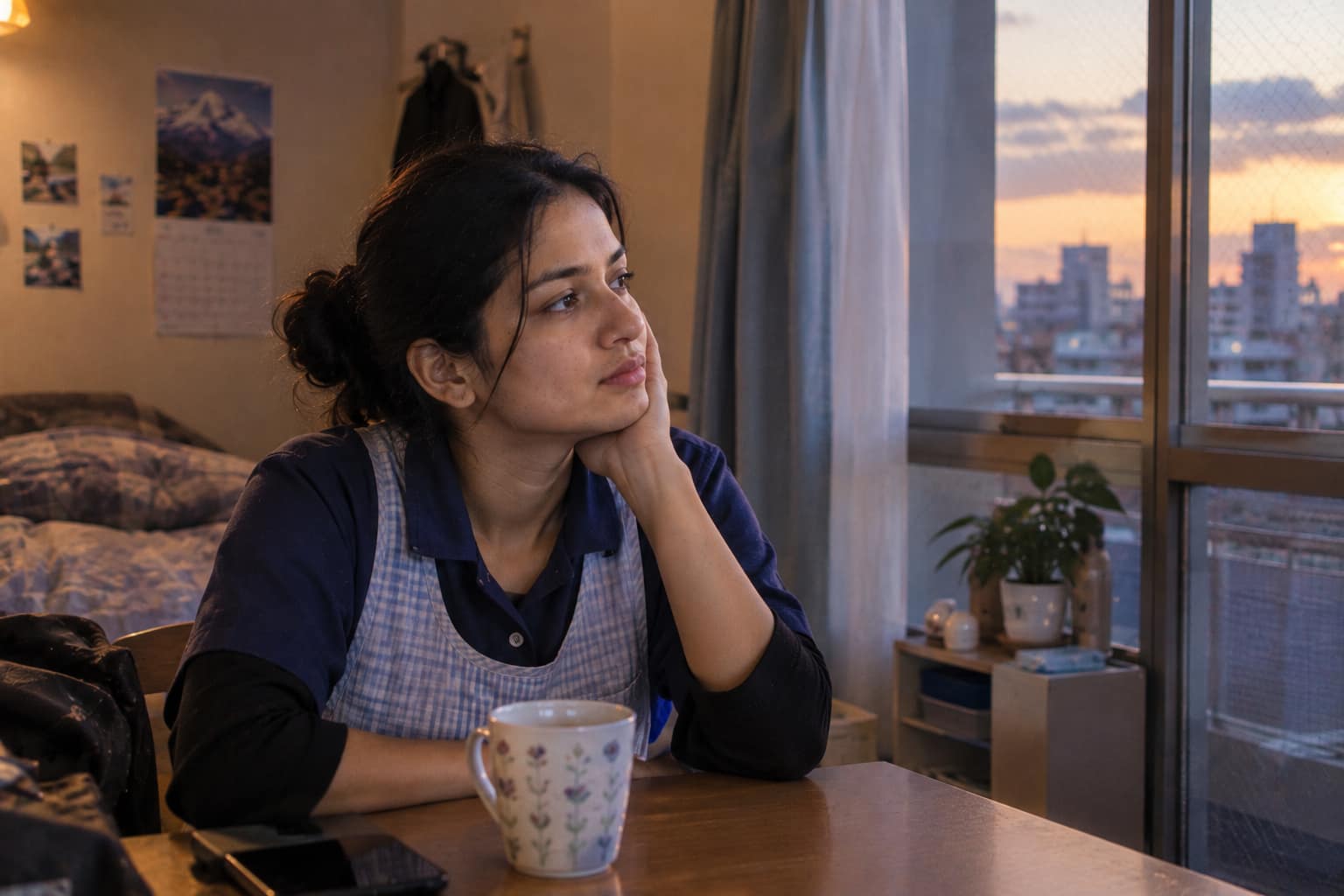
I am not mentally broken. But I am stressed. And after eight years of caregiving in Japan — seventeen-hour night shifts, difficult patients, senior-junior hierarchies, and a body that carries injuries that never fully healed — I think I have earned the right to say that honestly. This post is not about falling apart. It is about what it actually costs to keep going, and what I do when the weight becomes too heavy.
I want to start by saying something that most caregiving blogs will not say directly: the mental pressure of this job is real, it is heavy, and it does not go away with time. You learn to carry it differently. But it never disappears.
When I first came to Japan, I did not feel like quitting. I was new, I was motivated, and I had something to prove. That feeling lasted a few years. Somewhere around year six, something shifted. The exhaustion had accumulated in ways I had not noticed until it was already deep inside me. By year eight — now — the feeling of wanting to quit is not just mental. It is physical. My back hurts. My hand has not healed properly. And some days, finishing a shift feels like being released from a dark room where oxygen and light are rarely seen.
That is not a dramatic description. That is exactly what it feels like.
What actually causes the stress
People outside caregiving often assume the hardest part is the patients. And yes, difficult patients are part of it. Some patients insult you without reason. Some treat you as if you are beneath them. Some cause delays that make it impossible to finish your work on time. When that happens, you cannot respond. You cannot explain. You absorb it, complete your tasks, and move on. That emotional containment — doing it shift after shift, year after year — takes something from you that is hard to name.
But in my experience, the patient side is not the heaviest part. The heaviest part is the workplace culture.
Japan has a strong junior-senior hierarchy, and in caregiving this is felt intensely. You must listen to your seniors even when you disagree. Even when they are wrong. And some seniors — not all, but some — will blame you for things you did not do. If you try to explain yourself, you are told you are making excuses. There is no space to defend yourself, and no safe way to push back.
Many hospital caregiving environments in Japan also have older staff — caregivers in their 50s and 60s — who have worked the same way for decades. Some of these workplaces operate like what Japanese people call a black company — rigid, demanding, and indifferent to the wellbeing of the people working there. As a foreigner, you feel this more sharply. The expectation is that you perform perfectly, even when you are new. Even when you are still learning. There is very little patience for the learning curve.
The physical toll that becomes mental
A night shift in Japanese caregiving is long — my hospital runs 17 hours with a 4-hour break. But not every hospital is the same. Some facilities only give you a 2-hour break during a night shift. You do the work, rest for two hours, and go straight back. By the end of a shift like that, your body is not just tired — it is running on something you cannot name, and you will feel it for days after.
The physical demands of this work are severe, and when your body is under that kind of stress, your mental state follows. They are not separate things.
I injured my back and my hand in caregiving. Neither has healed completely. Living with chronic pain while continuing to do physically demanding work is its own kind of mental weight. You push through it because you have to. But pushing through it has a cost.
What I do when it gets heavy
I have one rule that has kept me functioning through eight years of this: I do not bring work stress home.
The moment I leave the hospital and return to my room, work ends. I bathe. I eat. I sit with something I enjoy — anime, donghua, a cup of tea or coffee. In the evening, I call my family back in Nepal. When I hear their voices, something in me settles. That phone call is not a small thing. It is one of the most reliable ways I know to feel like myself again.
I also walk. Evening walks — quiet streets, fresh air, no destination — reset something in my head that nothing else reaches in quite the same way. I have written about this before in my post on why I stay in Japan, because the small things — the parks, the quiet, the seasons — are part of what makes this country liveable even on the hard days.
I try not to spend too much time on my phone or laptop when I am already drained. Screen time when you are exhausted makes things worse, not better. Sleep — real, proper sleep — is the most important medicine. Nothing replaces it.
The goal is simple: recover enough to go back. Separate the two worlds completely, or you will not recover quickly enough to sustain this long term.
What I have seen happen to others
In my hospital, colleagues have resigned because they could not manage the mental pressure. Nurses and caregivers — not just foreign workers, Japanese staff too — take medication to cope with stress. This is treated as normal here. People around you continue as if nothing happened. Someone disappears from the schedule, and within a week, life at the facility goes on unchanged.
Japan does not talk about this enough. The culture of endurance — gaman — runs deep. You are expected to continue. To not complain. To absorb. And many people do, until they cannot.
I am not going to pretend I am immune to this. I feel it. The difference is that I have learned — slowly, over years — how to manage it before it manages me.
My honest advice
If you are struggling with the mental side of caregiving in Japan, please do not wait until you break to ask for help. In Japan, mental health support exists — employee assistance programs, counselling services, community health centers. Seeking help is not weakness. It is the opposite of weakness.
And if the job has genuinely taken too much from you — if your health, your body, and your mind are all telling you to stop — listen to them. No salary is worth your health. No visa is worth your sanity.
You have a family somewhere waiting for you. If survival is the goal, there are ways to survive that do not require destroying yourself in a foreign country. Go home. Do farming. Open a small shop. Live quietly. That is not failure. That is wisdom.
Life is more important than work. I believe that completely. And I say it as someone who has given eight years of their body and mind to this job.
My honest warning
Before you come to Japan for caregiving, understand this clearly: the mental pressure here is not something anyone will warn you about in the recruitment process. Agencies will show you the salary and the visa. They will not show you the 17-hour shifts, the senior who blames you for things you did not do, the patients who insult you and the fact that you cannot respond, or the colleagues quietly disappearing from the schedule because they broke under the pressure.
This is not said to scare you. It is said so you go in with your eyes open.
If you are not mentally prepared for this environment — if you have not built habits that protect your inner life — Japan’s caregiving world will take more from you than you expect. Know your limits before you reach them. Build your recovery habits before you need them. And never mistake endurance for strength.
Struggling with the physical side too? Read Physical Demands of Caregiving in Japan — What Nobody Warns You About.
Feeling like quitting? Read I Almost Quit Caregiving in Japan — Here’s What Stopped Me.
Want to understand the workplace culture better? Read Japan Work Culture Shock — What Foreign Caregivers Never Expect.
For more on how Japan’s care sector works from the outside: Foreign Elderly Care Workers in Japan — Unseen Japan
Leave a Reply